The Art of Collecting Christmas Music
Remember how record companies used to entice would-be customers to join their record clubs? You know, the mail-order offers of four or six or eight vinyl albums for only $.99 a pop as long as you purchased a minimum number of their selections-of-the-month or other albums of equal value? Columbia Record Club, which began the practice of marketing and distributing vinyl records in the late 1950s, led the way. RCA Record Club, a well as its Red Seal classical music label, and other record companies eventually followed suit.
Thirty years after hearing the sweet singing of carols by the Sisters of St. Joseph at my first Midnight Mass, I was in the process of assembling a small library of Christmas music. At the time I owned a medium-sized collection of pop and classical music, the latter for which I had acquired a taste during my teenage years, and my appreciation of Christmas music was definitely on the rise. To expand the library, I readily took advantage of Columbia and RCA marketing offers by enrolling in their record clubs. To maximize receiving benefits from each club, I would quickly fulfill my membership obligation by purchasing the minimum number of albums, and once I did, I would immediately cancel my membership. Since I was a member in good standing when I left, it wasn’t long before the same record clubs sent me new offers to join their clubs again. I almost always accepted, and the membership in-and-out cycle would repeat itself, thus enabling me to add significantly to my music library at a very reasonable cost.
But the record club that had the most impact on my assembling a substantial Christmas music library was The Musical Heritage Society of New Jersey. Like RCA’s Red Seal label, it too emphasized classical music as its reason d’être, and its annual Christmas catalog offerings, more generous and comprehensive in scope than the better known clubs, opened my eyes to the wonders of Renaissance, Baroque, and sacred music. What made these pre-CD era purchases possible were the amazing low prices, ranging from $2.50 and $5.45 per album or cassette.
My most memorable purchases, mostly from the Musical Heritage Society, included Michael Praetorius’ Christmas motets on period instruments, Italian Baroque Christmas concertos, colonial American hymns and carols, 15th-to-18th century English carols, especially those that were part of Benjamin Britton’s “A Ceremony of Carols,” and cantatas and oratorios by Back, Handel, and Mendelssohn. Adding to my delight were numerous albums of carols performed on a variety of instruments: organ, brass, harpsichord, panpipes, flute, carillon bells, harp, guitar, and music boxes. Other prized Christmas albums included performances by illustrious choirs and orchestras: the Choir of King’s College, Cambridge, the Vienna Boys Choir, and the Mormon Tabernacle Choir with the Philadelphia Orchestra, just to name a few.
By 1988 as a result of my systematic low-cost approach in taking advantage of various record club promotions, I had become the proud owner of a substantial Christmas music library. Later that year as I was feasting on my second helping of Thanksgiving turkey, a light bulb went on: Why not share my acquired riches with family and friends for Christmas!
SPECIAL PERSON OF THE DAY: Thomas Alexander Lacey (December 20, 1853 – December 6, 1931)
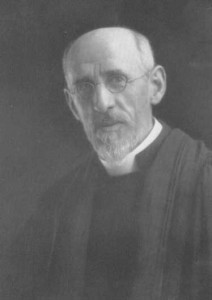
Rev. Thomas Alexander Lacey
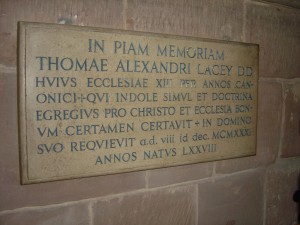
Canon Lacey memorial at Worcester Cathedral
Buried in Garth cloister at Worcester Cathedral, England, are the remains of the Rev. Thomas Alexander Lacey, an Anglican priest, who died on December 6, 1931. His special contribution to the carol hymn repertoire was providing the most popular English translation O Come, O Come Emmanuel for “Veni, Emmanuel.” His translation of the Latin verses, which were based upon the great O Antiphons for the week prior to Christmas and are included in my first publication Best-Loved Christmas Carols (2000), first appeared in The English Hymnal (1906), a labor of love he had work on for many days and nights.
A great conversationalist and scholar noted of his expertise in Medieval Latin and Canon, Rev. Lacey lived the Christian ideal very much like John Mason Neale, another Anglican priest and the composer responsible for the adaptation of the Latin lyrics for Veni, Emmanuel. Both priests drew suspicion from their Anglican superiors because of their Catholic leanings, and in particular the Rev. Lacey was an apologist for the Anglo-Catholic position and devoted to the cause of ecclesiastical reunion. Both priests also worked among the less privileged or the afflicted. Lacey was a dedicated worker on behalf of girls in penitentiaries, and he once worked tirelessly during a typhus outbreak that occurred when he served at St. Benedict’s in Ardwick by persuading those infected and reluctant to leave their homes to allow him to carry them into ambulances.
Rev. Lacey eventually became assistant master of Denstone College and was made a Fellow of the College of St. Mary and St. John, Lichfield. That was followed by his appointment as vicar of St. Edmund, Northampton, then vicar of Madingley, Cambridge, and later as chaplain and then warden at the House of Mercy in Highgate, where there is ample testimony he had led a saintly life. In 1919 he was made Canon at Worcester in which capacity he served until his death.

Ron Clancy’s Love of Christmas Music Began at an Early Age
It all started during the 1950 Christmas season. That was quite an exhilarating time for a six-year old boy at St. John’s Orphan’s Asylum in Philadelphia. For starters, Thanksgiving dinner was made a grand affair by the good folks of the Knights of Columbus who annually volunteered their time to fete hundreds of starry-eyed boys. The delicious platters of turkey and all the trimmings just kept on coming until every one of us had his fill. But that wasn’t all! After dessert of pumpkin or apple pie a la mode, we were all treated to a Disney movie. It was truly a delightful day, especially poignant for those hundreds of boys who had experienced so much deprivation before being taken in by the orphanage nuns, a wonderful and odd assortment of women, who, without exception, honored the preciousness of life by taking in all the hundreds.
The next four weeks of that holiday season brought one festive party after another. Hosted by local companies and colleges, we were giddy from all the excitement leading up to Santa’s big day. And when Villanova University students came by to treat us to a day in downtown Philadelphia, well, that was just the best. That meant shopping for our own Christmas gift at one of the Quaker City’s premium department stores – John Wanamaker, Strawbridge & Clothier, Lit Brothers, or Gimbels. It was a thrill just strolling along, or milling about, with bustling crowds of shoppers, most of whom were neatly groomed and dressed, and pausing every so often to behold the magical winter wonderlands on display in the large storefront windows. Our merriment was of untold, almost mystical, proportion, and the popular holiday songs and carols that filled the air only added to our festive mood. That was my first fond memory of the joys of Christmas music.
After shopping for our presents, the Villanova students treated us to a grand lunch at Horn and Hardart’s, a glass-and-chrome cafeteria styled coin-operated automat and Philadelphia institution since 1902. We were grateful for the treasury of coins pressed into our hands and then the selection process to buy Horn and Hardart’s delicious offerings began in earnest. Ten cents for macaroni and cheese! Twenty-five cents for a chicken pot pie! Ten cents for a small carton of milk! Fifteen-cents for lemon meringue pie! And to top it off, we were treated to a matinee double-header – a Laurel & Hardy short and the comedy Fancy Pants with Bob Hope and Lucille Ball that left us in stitches. All and all, it was a fantastic day for us orphan boys.
Finally, on a snow-dusted Christmas Eve, we were roused from our comfy beds for what would be for our first Midnight Mass. To this day I have never forgotten the feeling of awe I had then on entering the chapel. The crèche on the side of the altar was magnificent and easily caught my eye. There were the statues of the Baby Jesus wrapped in swaddling clothes and surrounded by Joseph and Mary, shepherds, ox, ass and sheep, and overhead was an angel bearing the good tidings. “Gloria in excelsis Deo. Et in terra pax hominibus bonae voluntatis.” (Glory to God in the highest. And one earth peace to men of good will.)
The ceremonial burning of frankincense only added to the drowsy and sweet intoxication caused by the lush fragrance of Christmas firs tethered to the pillars throughout the intimate chapel. But what mostly enhanced my wonderment, which made the occasion truly memorable, was the singing of Christmas carols. Sung beautifully by a small choir of nuns, the enchanting notes of the mystic “O Come, O Come, Emmanuel,” the reverential “Silent Night,” the Latin hymn “Adeste Fideles,” and other sacred carols seemed to spiral heavenward as though on the wings of angels. After that Midnight Mass and holiday season, I was hooked.
SPECIAL PERSON OF THE DAY: William E. Studwell (March 18, 1936 – August 2, 2010)
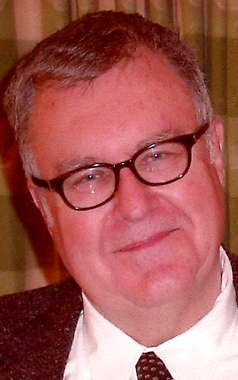
For the modern-day fraternity dedicated to preserving the history and legacy of Christmas carols, the recent death of William E. Studwell caused a great deal of sadness. A truly remarkable, as well as a great friend and trusted colleague, Studwell was a leading international authority on Christmas carols. His significant publication Christmas Carols: A Reference Guide (1985) is one of the best references on the subject and includes information on 789 carols. Publishing Glad Tidings: Essays on Christmas Music (1998), an excellent resource he co-authored, provides interesting insights about the personalities of major carol composers and carol book compilers. Other fine titles are his The Christmas Carol Reader (1995) and An Easy Guide to Christmas Carols: Their Past, Present and Future (2006), the latter which contains his list of the top 25 Christmas carols.
Despite suffering a neurological disorder that plagued him for a good portion of his life, that did not deter Prof. Studwell, as I like to address him, writing numerous articles about carols and other subjects, or editing nine of my Christmas music manuscripts in the mid-1990s, four of which have since been published. One of his favorite activities, though, was bequeathing to the public his annual “Carol of the Year,” a practice he began in 1986.
This year will be the 25th anniversary of his special holiday h’ors d’oeuvre, but sadly it will be his last. Prof. Studwell, though, must have sensed his end was near, having fallen ill with lymphoma earlier in the year. The day before he died he corresponded with his daughter Laura with specific details about his final installment of “Carol of the Year,” which will soon be published.
Prof. Studwell was an affable sort who was also much respected among academic librarians. The seventh child of a lower-middle class working family from Stamford, Connecticut, he once worked for the Library of Congress in the technical division of the Soviet and Russian collection, and there he developed an interest in Library Science. Three years after earning a Master of Library Science degree from Catholic University in 1967, he became head cataloger at the University of Libraries, Northern Illinois University where he distinguished himself for thirty-one years as the best library cataloger in the United States. At the same time, too, he was bringing honor to the annals of Christmas music by writing prodigiously on the topic. To those of us who are keenly aware of his work, he has rightfully carved out a special place for himself in the pantheon of Christmas carol contributors.


