Christmas Classics PERSON OF THE DAY: Billy Hayes III
On August 12, 1993, Billy Hayes III died in his home town of Brooklyn, New York. The songwriter, guitarist, and nightclub performer is best known for his collaboration with his friend Jay W. Johnson to compose Blue Christmas. It was Johnson, a script and jingle writer for radio, who came up with the song idea in 1948 on one of his daily commute rides to New York. Hayes helped to put the finishing touches to the song before it was presented to Choice Music Co., which soon released the first recording of Blue Christmas.
In 1949 Blue Christmas was recorded by three different artists: two by big band leaders, Russ Morgan and Hugo Winterhalter, and the third by Ernest Tubb, the popular country singer. Tubb’s version became most popular in 1950, but his rendition was ultimately eclipse in popularity in 1957 when Elvis Presley included the country genre Christmas song in his Christmas album. In 1964 Elvis recorded it as a single and since then it has become an annual Christmas standard.
Although Billy Hayes is credited with a number of other songs, such as Play Fair, Yesterday’s Kisses, Tomorrow’s Just Another Day to Cry, Got a Ring Around Rosie’s Finger, and Who Shot the Hole in My Sombrero, his claim to fame is mostly tied to his signature song – Blue Christmas.
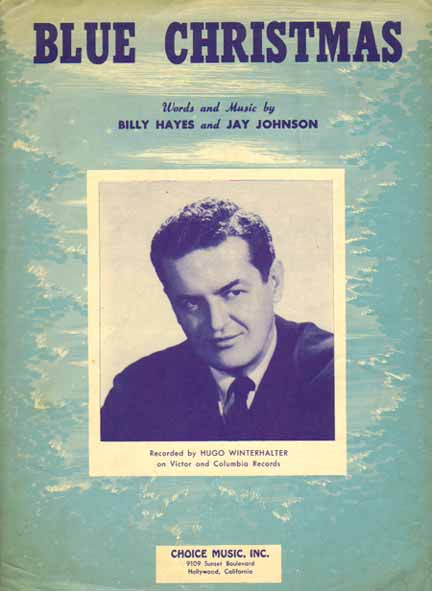
BLUE CHRISTMAS
sheet music with
Hugo Winterhalter

Christmas Classics PERSON OF THE DAY: Robert Lewis May
On this day in 1976, Robert Lewis May died. His fame rests as the author who in 1939 wrote the story of Rudolph for which his brother-in-law, Johnny Marks, wrote a tune in 1948 titled Rudolph the Red-Nosed Reindeer. By the following year it was released as a recording, one that would become one of the most successful Christmas songs of all time.
How Rudolph the Red-Nosed Reindeer became a huge success began as a simple request by Robert May’s boss at Montgomery Ward, the mail-order giant. The advertising executive asked May, the department’s copywriter, to write a cherry Christmas story in booklet form with an animal theme for its customers. In previous years Montgomery Ward gave away coloring books to its customers, but decided in 1939 to create its own booklet to save money.
At the time May was beset with problems at home. His wife, Evelyn, was suffering from an advanced case of cancer. His station in life was considerably less than what he had been used to. Raised in an affluent Jewish family in New Rochelle, New York, and graduating from Dartmouth College in 1926 with Phi Beta Kappa honors, his road ahead seemed quite promising. Then the stock market crashed in 1929 and with it the loss of his family’s wealth. Sometime during the 1930s he moved to Chicago, taking on a low-paying job as a copywriter for Montgomery Ward.
May took to the task and began the story of Rudolph in earnest. Drawing upon his memory as a painfully shy child, he decided to use a singular reindeer as the main character for the story. He was also mindful that his daughter Barbara loved the reindeer at the Chicago Zoo. It was during that early stage of writing Rudolph in July 1939 when Evelyn died. In light of her death, May’s boss offered him release from the story assignment, but May refused. Spurred on by grief and by his daughter’s encouragement, May wrote and rewrote the story, constantly reading it to Barbara for her approval until both agreed in late August 1939 that the final version was ready for Montgomery Ward.
The story of Rudolph the Red-Nosed Reindeer was first distributed to 2.4 million store customers during the 1939 Christmas season. They loved it! Due to World War II restrictions and the consequent shortage of paper, it wasn’t until 1946 when the company reissued the story to the tune of 3.6 million copies.
Although Montgomery Ward owned the copyright to the Rudolph story and despite the story’s tremendous appeal, Sewell Avery, the company president, as a gesture of eternal gratitude gave May the copyright to the story. Rudolph eventually was updated and published in 1947 as a colorfully illustrated book by a small New York publishing company. It became an instant best-seller.
May eventually married an employee of Montgomery Ward. Her name was Virginia, a devout Catholic, and together they had five children. May was also famous for growing the most amazing tomatoes, some of which grew to 12 feet tall. His fame,though, largely rests for penning a favorite holiday story that was borne out of grief and a sense of not belonging, ultimately becoming triumphant through the love of a child.
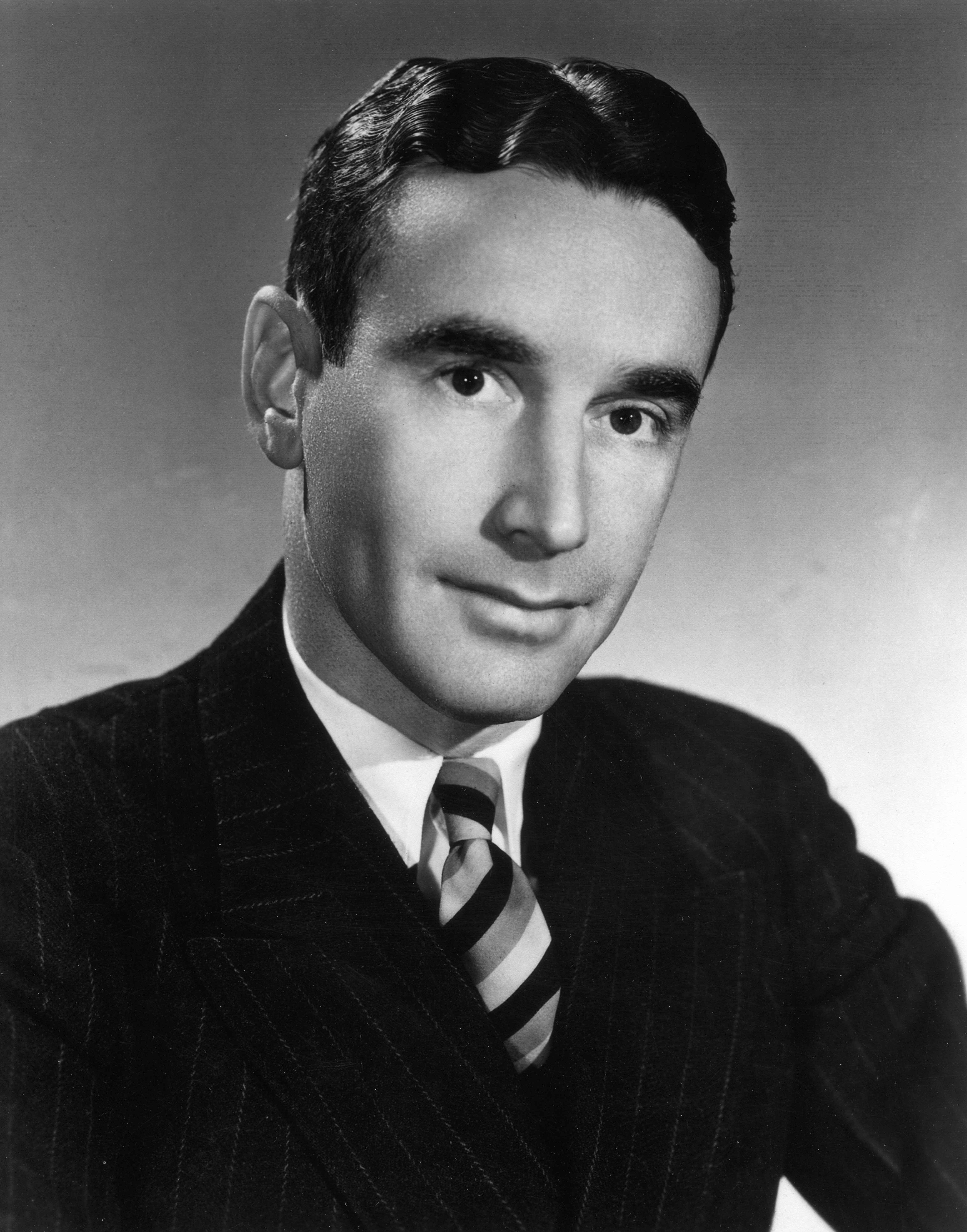
Robert L. May
Christmas Classics PERSON OF THE DAY: John Wesley Work, Jr.
Also on this day in 1871, John Wesley Work, Jr. was born in Nashville, Tennessee. Considered one of the first, if not the first, serious black collector of Negro folk songs, he too studied Latin and Greek, as well as history, and taught the two classic languages after he received a Master’s degree from Fisk University in 1898.
For the next twenty-five years Work Jr. became a leader in the effort to study and preserve Negro spirituals. At the same time he organized Fisk singing groups, and with the help of his wife Agnes and his brother Frederick Jerome Work, collected and published a number of collections of slave songs and spirituals. The first of these collections was New Jubilee Songs as Sung by the Fisk Jubilee Singers (1901).
Six years later he published, and may have composed, the remarkable spiritual Go Tell It on the Mountain, as part of New Jubilee Songs and Folk Songs of the American Negro.
Many of the spirituals the Works collected had originally been sung by their forebears as they toiled in the fields, or at difficult manual labor, during the dark age of slavery. It was one way of establishing relationships and feeling that God was near. The story of Christmas, of God’s Son being born as man to redeem and free man of his sins, was important in itself and as a symbol of hope in their quest for freedom
The legacy of Negro spirituals was important to Work Jr. as he became both the leader and performer of the Fisk University Jubilee Singers, the historic choral group founded in 1871 for the purpose of raising funds for the post-Civil War black college whose severe financial problems almost shut the school down. The Jubilee Singers, who took their name from the year of freedom in the Bible, were quite successful on their tours of the United States and Europe, which included a bravo performance for Queen Victoria of England, and in the process they raised the Negro spiritual to an art form.
For eighteen years Work Jr. served as leader of the Jubilee Singers until negative opinion set in at Fisk against the Negro spiritual as only a painful reminder of slavery. This groundswell of negative feelings toward black folk music forced Work Jr. to resign his leadership post in 1923. For the balance of his life, he served as president of Roger Williams University until his death on September 7, 1925.
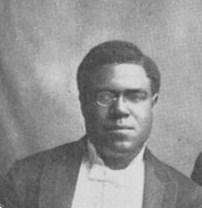
John Wesley Work, Jr.
Christmas Classics PERSON OF THE DAY: Rev. John Mason Neale
On this day in 1866, the Rev. John Mason Neale died. A humble and scholarly Anglican priest, his reputation largely rests with his research and translations of ancient Greek and Latin religious texts, tasks that must have come easily to him since he was proficient in twenty-one different languages. The contributions of Neale to the revitalization of ancient and medieval church hymns and his deft translations of them cannot be underestimated. The brilliant scholar was known to have lamented the Reformation’s neglect of the rich history of hymnody, despite the movement’s praiseworthy restoration of worship and song to the language of the common people.
The Rev. Neale was also a well-respected composer of Christmas carols and hymns, some of which were delivered as a result of translating centuries-old hymns and songs, including those of a secular strain.
Three of those carols have grown quite popular since the publication of his 1853 collection Neale’s Carols for Christmastide. The most sacred was the carol hymn Veni, Emmanuel (O Come, O Come Emmanuel) based upon the Latin great O Antiphons of Advent whose seven verses are believed to have been composed by monastery monks who sang one verse per day at Vespers, the late afternoon or early evening canonical hour of prayer, for seven straight days prior to Christmas Eve.
Good Christian Men, Rejoice, the second carol, was Neale’s loose English translation of one of Germany’s best-loved carols, In Dulci Jubilo. Neale found the melody of this medieval Latin-German carol in Piae Cantiones, the famous 1582 Swedish book of carols that also produced the tune for Good King Wenceslas, the third familiar carol. For the latter, Neale was looking for a good role model for children. He found it in King Wenceslas of Bohemia who was known to be a just and merciful king and having considerable compassion for the poor and sick.
It could be said that King Wenceslas was also a role model for Neale himself since he, too, led an exemplary life by dedicating his life to the less fortunate. The hymn composer had a penchant for caring for the lowliest on society’s scale, and his Christian deeds set him apart from other clerics holding more lofty positions in the Anglican Church.
Such was Neale’s station in life that his own bishop, imagining Neale of Roman Catholic leanings, prohibited him from performing any ministerial duties and relegated him to a seemingly less desirable post. Thus, in 1846 Neale was made warden of Sackville College, a position he held for the rest of his life. Sackville College, however, was actually an almshouse, a charitable residence for the poor and aged. Twelve years later the humbly intrepid, and often frail and sickly, Neale founded the Sisterhood of St. Margaret, a group dedicated to the poor, needy, and suffering. For this charitable effort he was accused of a return to nuns, again earning him the enmity of Church authorities that thought he was converting to the Roman Catholic faith. Neale’s ministry later established an orphanage, a school for girls, and a home for unwed mothers, the latter forced to close due to church and local opposition. In a nutshell, Neale’s dedication to serving the poor and indigent was on a level with that of his work with sacred texts and hymns. Each pursuit was performed tirelessly, with dignity, and for the higher good.
Emmanuel, meaning “God with us,” is a splendid title for a carol hymn. It must have held special significance to Rev. Neale as he worked among the poor. The title reaffirms the religious concept of Christ’s birth as God Incarnate dwelling among men and announcing to them his mission here on earth. In the world of the ancient Hebrew, the choice of name was made judiciously, as the name Emmanuel must have been for Neale. For the scholarly Anglican priest, the name radiated in bold light and demonstrated, coincidentally, his own essential character and purpose as a man.
Today the Rev. Neale lays in peace at St. Swithun churchyard in East Grinstead, England, close to Sackville College where he abundantly served so well those who had so little.
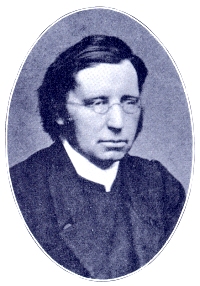
Rev. John Mason Neale
Christmas Classics PERSON OF THE DAY: Rev. Charles Lewis Hutchins
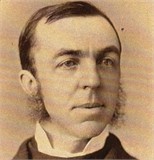
Rev. Charles Lewis Hutchins was born on this day in 1838. He was an Episcopal minister who graduated from the General Theological Seminary, New York City. He is known for producing a number of books and hymnals for the Episcopalian Church, including his largest volume Carols Old and Carols New: For Use at Christmas and Other Seasons of the Christian Year (Boston: Parish Choir, 1916). The massive collection contained 751 carols, about 470 dedicated to Christmas, and it remains one of the largest ever printed in the English language. The carols were international in scope, mostly from Europe and the United States, and included both favorite and lesser known carols.
Carols Old and Carols New: For Use at Christmas and Other Seasons of the Christian Year had a limited printing of a thousand copies, but it contained unusual features for its day, such as a preface, a composer and music source index, a first-line index, and some information about the authorship of carols.
Rev. Hutchins died on August 17, 1920 in Concord, Massachusetts. He is buried in Sleepy Hollow Cemetery, a famous last resting place for some of New England’s great 19th century authors and transcendental poets, as well as Katherine K. Davis, the composer of the popular carol The Little Drummer Boy.
Charles L. Hutchins
Christmas Classics PERSON OF THE DAY: Guillaume Dufay
On this day in 1397 Guillaume Dufay was born. An important Franco-Flemish composer, he was instrumental in the transition from Medieval to Renaissance music. His reputation grew during his years in Italy when he earned the sobriquet as “the greatest ornament of our age.” He was also a Catholic priest who served the choir of the Papal Chapel in Rome from 1428 to 1443. It is understandable then why much of his musical output was devoted to church liturgy, including polyphonic works for Masses. motets, and hymns, some of which were dedicated to Advent and Christmas.
Dufay’s reputation asone of the most influential composers of the 15th century was well earned, evidence of which can be found in the works of succeeding composers who emulated some elements of his musical style. His embellishment of austere medieval plainchant by employing mellifluous harmonies made singing church music more pleasant to the ear, thus elevating church music of his day and further establishing the Mass as the main platform for elaborate polyphony.
The composer’s music appeal also extended into the secular realm, for there he also made his mark felt, and his melodic style would ultimately became characteristic of the early Renaissance. There is little doubt about Dufay’s unique contributions to the evolution of Western music, and today he still holds a special place in the pantheon of great composers.

Guillaume Dufay
How I Created Exquisite Christmas Music Collections
When starting a new business venture, first things first: write the business plan! And so it was on January 8, 1989 that I began the task in earnest. My objective was clear: offer customers exquisite alternatives to Reader’s Digest and Time-Life Christmas music collections.
These Christmas music collections would include not only classic recordings of Christmas carols, music, and holiday songs, but they would also come with lavishly illustrated books about the fascinating stories behind the carols and music.
The question was what should I call these grand collections? After scribbling down a number of variations, I settled upon "A Christmas Festival of Great Music, Songs, and Carols" as the working title. My business plan’s mission statement read: To form a Sub-chapter S Corporation for the purpose of launching A Christmas Festival of Great Music, Songs, and Carols; a combination Christmas book/audio package, and to make it the best-selling product in its niche market that will produce significant profit margins. I envisioned these ne plus ultra collections were going to sell like hotcakes! Revenues were anticipated to run into the millions and the collections would be sold throughout the Christian world; especially in North America and Europe.
With a blueprint of action in hand, the plan to launching eleven distinct collections. The initial focus was to develop a deluxe collection that would be comprised of one hundred and eighty-five titles. After its projected launch into the Christmas music market, ten smaller collections including material from the deluxe model were to follow. But there was a problem with this business model, and it would rear its head in the future.
In the meantime, the agenda called for doing the requisite research on the origins and stories of Christmas music. It was done the old fashion way with pen, pencil, and paper, and typewriter before I conceded to the modern need for a computer. And it was during this phase of eleven years when the Music Department staff of the Free Library of Philadelphia found a frequent visitor parked in their midst.
SPECIAL PERSON OF THE DAY – James Ramsey Murray (March 7, 1841 – March 10, 1905)
. 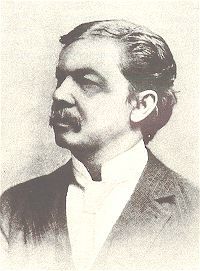
James Ramsey Murray was the likely composer of the more familiar music for the Christmas carol Away in a Manger. The tender lullaby was once thought to have been composed by Martin Luther (1483-1546), the great German religious reformer, and it was often referred to as Luther’s Cradle Hymn. However, by the 1940s it was proven conclusively that the music had actually been composed by James Ramsey Murray, supposedly the same person who perpetrated the myth of Luther’s Cradle Hymn. Murray, who might also have used the pseudonym of Mueller, a name totally untraceable yet found in association with “Away in a Manger” in many hymnals. Ramsey may have y allowed his fanciful imagination to get the better of him, certainly not the first time that someone got enthusiastic about the Christmas experience, and his lullaby was included in an 1887 Cincinnati collection called Dainty Songs for Lads and Lasses.
Born in Andover, Massachusetts, Murray studied at the Musical Institute in North Reading of his home state, along with Lowell Mason, a composer noted for his association with the carol Joy to the World. During the Civil War Murray served as an army musician, and after the war he worked in Chicago for the Root and Cady publishing house as editor of the Song Messenger. He remained with that company until the Great Chicago Fire of 1871, after which he returned to Andover to teach music in the public schools. It was also in Chicago where Charles H. Gabriel, the music director of Grace Methodist Episcopal Church, discovered another version of Away in a Manger in 1892. Eventually Murray moved to Cincinnati where he was editor of music books, including the Musical Visitor, published by the John Church Company. It was while there he came upon Away in a Manger, which was probably composed in the mid-19th century and passed down orally through the years.
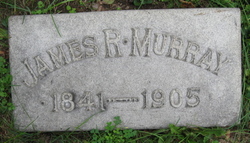
Today Murray rests in peace in Section 71, Lot 207 at Spring Grove Cemetery in Cincinnati
. 
Christmas 1988 Starts Me on the Yellow Brick Road
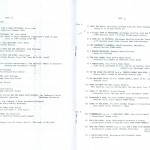
In 1988 I thought it would be a neat idea to share the riches of my Christmas music collection. So for Christmas I gift-wrapped four audio cassettes of the finest recordings from my collection and gave them to family and friends. Each gift collection was accompanied by an 8-page type-written directory with a Chinese red cover titled “A Gift of Sound.” Besides having a decorative, though primitive look, the directory of song titles was intended to be easier on the eyes than my barely legible long-hand. Just imagine writing the same information on cassette index cards four times twelve, or forty-eight total! The thought was enough to give me writer’s cramps. My quaint IBM Selectric II typewriter, however, saved me the trouble and as a result the directory included not only selection titles, but also brief liner notes that sometimes indicated the origin of each carol, holiday song, or instrumental piece.
Some of my friends included those of the Jewish faith married to Christian partners. They admitted that although they usually felt left out at Christmas, they were indeed appreciative of my eclectic Christmas music gift. What made the collection special for most was the quality of the music. Quite unlike what they were accustomed to hearing during the holidays, it encompassed Gregorian chant, once the Christmas music of its day, and such classical pieces as "Anima Nostra,” Bach’s “Christmas Oratorio,” the German motet ""Hort zu lieben Leute," and the Spanish villancico, "Riu, Riu, Chiu” just to name a few. The collection was rounded out by lyrical English carols from the 16th and 17th centuries, and better known traditional fare, particularly carol hymns as "O Come, O Come Emmanuel” and “Adeste Fidelis,” or classic holiday songs as “White Christmas,” and “The Christmas Song.” In all, the four cassette collection totaled one hundred and twenty-four titles. Most came from England, France, Germany, and the United States. Entries from Austria, Czechoslovakia, Poland, Italy, and Sweden were also part of the mix. By the end of the 1988 Christmas season I was being encouraged by several friends to do something about my great interest in Christmas music, suggesting that I should pursue my interest and take advantage of my college degree. This I did. And in 1989 I was on my way.
SPECIAL PERSON OF THE DAY – Émile Waldteufel (December 9, 1837 – February 12, 1915)
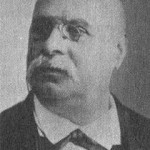
The composer of Les Patineurs, Op. 183, Émile Waldteufel died in Paris and is buried at Cimetière du Père Lachaise there. The composer was born in Strasbourg, France to a Jewish Alsatian family of musicians. In 1882 he composed the best-known waltz of his career – Les Patineurs (a.k.a. "The Skaters’ Waltz" in English). Inspired by the Cercle des Patineurs, or "’Rink of Skaters’ at the Bois de Boulogne in Paris, the waltz has since been played in various venues, from concert halls to movies such as The Hollywood Revue of 1929 and Chariots of Fire, to music games like Gamecube’s “’Dance Dance Revolution Mario Mix” and Arc System Works’ “Princess on Ice.”
Waldteufel’s famous waltz evokes wonderful imagery: a poised skater gracefully gliding along the ice and swirling about a ring of other skaters as part of the wintry atmosphere. The delightful music includes the sound of bells that adds a nice touch to the outdoor scene. The noted conductor Arturo Toscanini led the NBC Symphony Orchestra on January 28, 1945, at Carnegie Hall, New York, in a fine RCA Victor recording of Les Patineurs
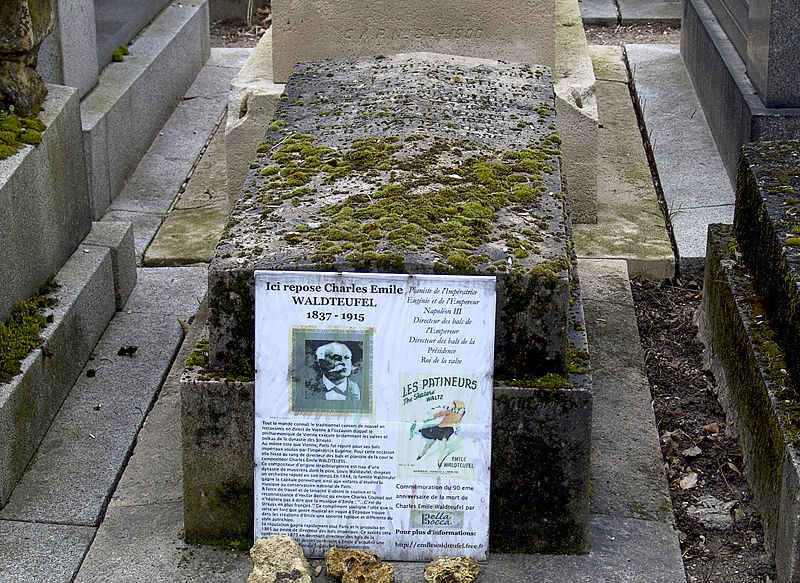
Grave of Émile Waldteufel
The Art of Collecting Christmas Music
Remember how record companies used to entice would-be customers to join their record clubs? You know, the mail-order offers of four or six or eight vinyl albums for only $.99 a pop as long as you purchased a minimum number of their selections-of-the-month or other albums of equal value? Columbia Record Club, which began the practice of marketing and distributing vinyl records in the late 1950s, led the way. RCA Record Club, a well as its Red Seal classical music label, and other record companies eventually followed suit.
Thirty years after hearing the sweet singing of carols by the Sisters of St. Joseph at my first Midnight Mass, I was in the process of assembling a small library of Christmas music. At the time I owned a medium-sized collection of pop and classical music, the latter for which I had acquired a taste during my teenage years, and my appreciation of Christmas music was definitely on the rise. To expand the library, I readily took advantage of Columbia and RCA marketing offers by enrolling in their record clubs. To maximize receiving benefits from each club, I would quickly fulfill my membership obligation by purchasing the minimum number of albums, and once I did, I would immediately cancel my membership. Since I was a member in good standing when I left, it wasn’t long before the same record clubs sent me new offers to join their clubs again. I almost always accepted, and the membership in-and-out cycle would repeat itself, thus enabling me to add significantly to my music library at a very reasonable cost.
But the record club that had the most impact on my assembling a substantial Christmas music library was The Musical Heritage Society of New Jersey. Like RCA’s Red Seal label, it too emphasized classical music as its reason d’être, and its annual Christmas catalog offerings, more generous and comprehensive in scope than the better known clubs, opened my eyes to the wonders of Renaissance, Baroque, and sacred music. What made these pre-CD era purchases possible were the amazing low prices, ranging from $2.50 and $5.45 per album or cassette.
My most memorable purchases, mostly from the Musical Heritage Society, included Michael Praetorius’ Christmas motets on period instruments, Italian Baroque Christmas concertos, colonial American hymns and carols, 15th-to-18th century English carols, especially those that were part of Benjamin Britton’s “A Ceremony of Carols,” and cantatas and oratorios by Back, Handel, and Mendelssohn. Adding to my delight were numerous albums of carols performed on a variety of instruments: organ, brass, harpsichord, panpipes, flute, carillon bells, harp, guitar, and music boxes. Other prized Christmas albums included performances by illustrious choirs and orchestras: the Choir of King’s College, Cambridge, the Vienna Boys Choir, and the Mormon Tabernacle Choir with the Philadelphia Orchestra, just to name a few.
By 1988 as a result of my systematic low-cost approach in taking advantage of various record club promotions, I had become the proud owner of a substantial Christmas music library. Later that year as I was feasting on my second helping of Thanksgiving turkey, a light bulb went on: Why not share my acquired riches with family and friends for Christmas!
SPECIAL PERSON OF THE DAY: Thomas Alexander Lacey (December 20, 1853 – December 6, 1931)
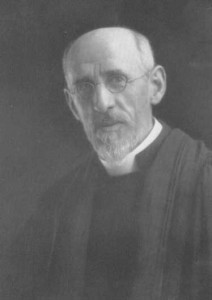
Rev. Thomas Alexander Lacey
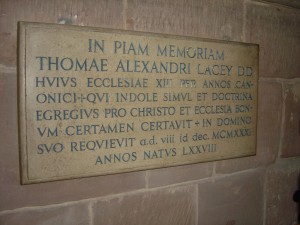
Canon Lacey memorial at Worcester Cathedral
Buried in Garth cloister at Worcester Cathedral, England, are the remains of the Rev. Thomas Alexander Lacey, an Anglican priest, who died on December 6, 1931. His special contribution to the carol hymn repertoire was providing the most popular English translation O Come, O Come Emmanuel for “Veni, Emmanuel.” His translation of the Latin verses, which were based upon the great O Antiphons for the week prior to Christmas and are included in my first publication Best-Loved Christmas Carols (2000), first appeared in The English Hymnal (1906), a labor of love he had work on for many days and nights.
A great conversationalist and scholar noted of his expertise in Medieval Latin and Canon, Rev. Lacey lived the Christian ideal very much like John Mason Neale, another Anglican priest and the composer responsible for the adaptation of the Latin lyrics for Veni, Emmanuel. Both priests drew suspicion from their Anglican superiors because of their Catholic leanings, and in particular the Rev. Lacey was an apologist for the Anglo-Catholic position and devoted to the cause of ecclesiastical reunion. Both priests also worked among the less privileged or the afflicted. Lacey was a dedicated worker on behalf of girls in penitentiaries, and he once worked tirelessly during a typhus outbreak that occurred when he served at St. Benedict’s in Ardwick by persuading those infected and reluctant to leave their homes to allow him to carry them into ambulances.
Rev. Lacey eventually became assistant master of Denstone College and was made a Fellow of the College of St. Mary and St. John, Lichfield. That was followed by his appointment as vicar of St. Edmund, Northampton, then vicar of Madingley, Cambridge, and later as chaplain and then warden at the House of Mercy in Highgate, where there is ample testimony he had led a saintly life. In 1919 he was made Canon at Worcester in which capacity he served until his death.
Ron Clancy’s Love of Christmas Music Began at an Early Age
It all started during the 1950 Christmas season. That was quite an exhilarating time for a six-year old boy at St. John’s Orphan’s Asylum in Philadelphia. For starters, Thanksgiving dinner was made a grand affair by the good folks of the Knights of Columbus who annually volunteered their time to fete hundreds of starry-eyed boys. The delicious platters of turkey and all the trimmings just kept on coming until every one of us had his fill. But that wasn’t all! After dessert of pumpkin or apple pie a la mode, we were all treated to a Disney movie. It was truly a delightful day, especially poignant for those hundreds of boys who had experienced so much deprivation before being taken in by the orphanage nuns, a wonderful and odd assortment of women, who, without exception, honored the preciousness of life by taking in all the hundreds.
The next four weeks of that holiday season brought one festive party after another. Hosted by local companies and colleges, we were giddy from all the excitement leading up to Santa’s big day. And when Villanova University students came by to treat us to a day in downtown Philadelphia, well, that was just the best. That meant shopping for our own Christmas gift at one of the Quaker City’s premium department stores – John Wanamaker, Strawbridge & Clothier, Lit Brothers, or Gimbels. It was a thrill just strolling along, or milling about, with bustling crowds of shoppers, most of whom were neatly groomed and dressed, and pausing every so often to behold the magical winter wonderlands on display in the large storefront windows. Our merriment was of untold, almost mystical, proportion, and the popular holiday songs and carols that filled the air only added to our festive mood. That was my first fond memory of the joys of Christmas music.
After shopping for our presents, the Villanova students treated us to a grand lunch at Horn and Hardart’s, a glass-and-chrome cafeteria styled coin-operated automat and Philadelphia institution since 1902. We were grateful for the treasury of coins pressed into our hands and then the selection process to buy Horn and Hardart’s delicious offerings began in earnest. Ten cents for macaroni and cheese! Twenty-five cents for a chicken pot pie! Ten cents for a small carton of milk! Fifteen-cents for lemon meringue pie! And to top it off, we were treated to a matinee double-header – a Laurel & Hardy short and the comedy Fancy Pants with Bob Hope and Lucille Ball that left us in stitches. All and all, it was a fantastic day for us orphan boys.
Finally, on a snow-dusted Christmas Eve, we were roused from our comfy beds for what would be for our first Midnight Mass. To this day I have never forgotten the feeling of awe I had then on entering the chapel. The crèche on the side of the altar was magnificent and easily caught my eye. There were the statues of the Baby Jesus wrapped in swaddling clothes and surrounded by Joseph and Mary, shepherds, ox, ass and sheep, and overhead was an angel bearing the good tidings. “Gloria in excelsis Deo. Et in terra pax hominibus bonae voluntatis.” (Glory to God in the highest. And one earth peace to men of good will.)
The ceremonial burning of frankincense only added to the drowsy and sweet intoxication caused by the lush fragrance of Christmas firs tethered to the pillars throughout the intimate chapel. But what mostly enhanced my wonderment, which made the occasion truly memorable, was the singing of Christmas carols. Sung beautifully by a small choir of nuns, the enchanting notes of the mystic “O Come, O Come, Emmanuel,” the reverential “Silent Night,” the Latin hymn “Adeste Fideles,” and other sacred carols seemed to spiral heavenward as though on the wings of angels. After that Midnight Mass and holiday season, I was hooked.
SPECIAL PERSON OF THE DAY: William E. Studwell (March 18, 1936 – August 2, 2010)
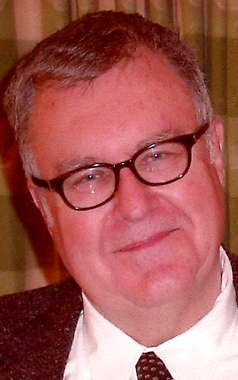
For the modern-day fraternity dedicated to preserving the history and legacy of Christmas carols, the recent death of William E. Studwell caused a great deal of sadness. A truly remarkable, as well as a great friend and trusted colleague, Studwell was a leading international authority on Christmas carols. His significant publication Christmas Carols: A Reference Guide (1985) is one of the best references on the subject and includes information on 789 carols. Publishing Glad Tidings: Essays on Christmas Music (1998), an excellent resource he co-authored, provides interesting insights about the personalities of major carol composers and carol book compilers. Other fine titles are his The Christmas Carol Reader (1995) and An Easy Guide to Christmas Carols: Their Past, Present and Future (2006), the latter which contains his list of the top 25 Christmas carols.
Despite suffering a neurological disorder that plagued him for a good portion of his life, that did not deter Prof. Studwell, as I like to address him, writing numerous articles about carols and other subjects, or editing nine of my Christmas music manuscripts in the mid-1990s, four of which have since been published. One of his favorite activities, though, was bequeathing to the public his annual “Carol of the Year,” a practice he began in 1986.
This year will be the 25th anniversary of his special holiday h’ors d’oeuvre, but sadly it will be his last. Prof. Studwell, though, must have sensed his end was near, having fallen ill with lymphoma earlier in the year. The day before he died he corresponded with his daughter Laura with specific details about his final installment of “Carol of the Year,” which will soon be published.
Prof. Studwell was an affable sort who was also much respected among academic librarians. The seventh child of a lower-middle class working family from Stamford, Connecticut, he once worked for the Library of Congress in the technical division of the Soviet and Russian collection, and there he developed an interest in Library Science. Three years after earning a Master of Library Science degree from Catholic University in 1967, he became head cataloger at the University of Libraries, Northern Illinois University where he distinguished himself for thirty-one years as the best library cataloger in the United States. At the same time, too, he was bringing honor to the annals of Christmas music by writing prodigiously on the topic. To those of us who are keenly aware of his work, he has rightfully carved out a special place for himself in the pantheon of Christmas carol contributors.


